
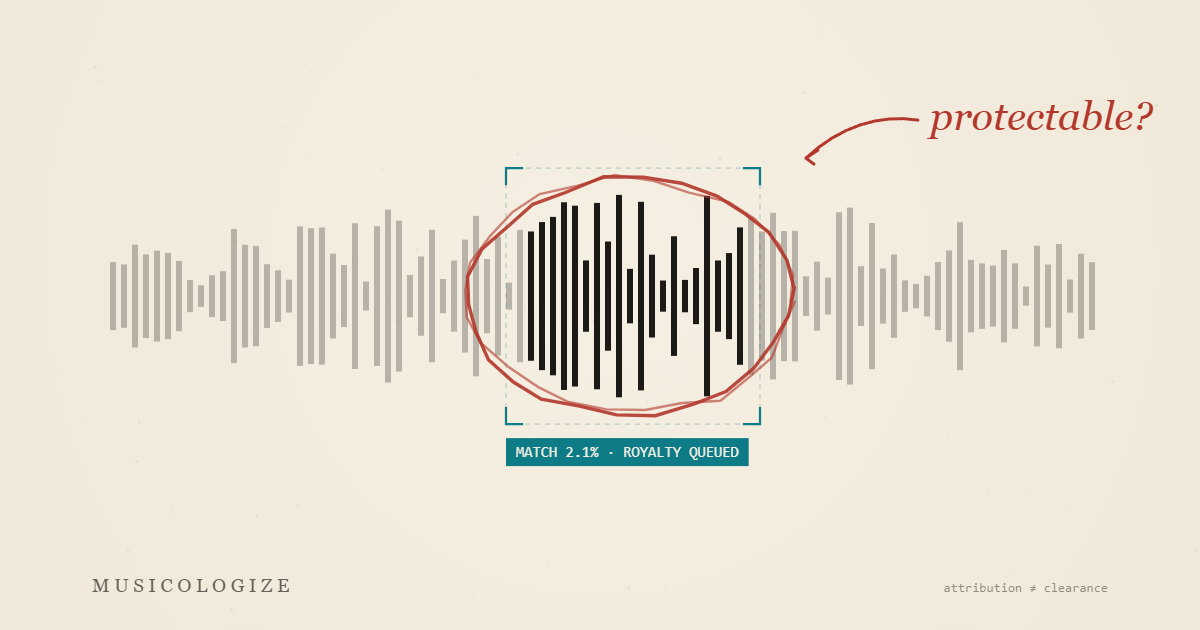

The music industry and adjacent ambitious software devs are building tools to pay artists for AI. From a copyright standpoint, it’s nonsensical. But maybe that doesn’t matter.
Attribution is an appealing engineering project.
The question of whether AI was trained on copyrighted material is settled. Duh. But the question of whether it was illegal to do it, well, I don’t expect that to ever be answered. The risk for litigating it is too much for either side to bear. So instead, how bout this idea?! We score the influence, the labels sign settlements and drop the training-based cases, platforms cut checks to TMCI, our weighted Total Music Creators Index (I made that up.) All of it sends tons of real money around and it becomes standard practice without any of it becoming or even resembling law.
Attribution is something else.
If Beyoncé wants to give attribution for something that was in her head when she created a track, that’s her prerogative. And she springs to mind because she’s done it more graciously than I’d ever bless. Fine, but that’s not copyright. That’s either generosity, creative honesty, soul soothing, charity, or whatever. But it is not a nod to copyright infringement; certainly not regularly. The creator is only on the hook for the protectable expression in a prior work that lives in the new work. Protectable expression. An attribution tool that estimates whose music influenced a model or an output and routes money accordingly ignores that. Influence is irrelevant. My breakfast omelet was influenced, but Jacques Pépin ain’t gonna see a franc. Copyright protects specific protectable expression against substantial copying, judged after the commonly held layer of melody, harmony, rhythms, structure, and vocabulary has been considered; filtered if you like. A track can score 4% Billy Joel on a detector, or a lot higher, and infringe nothing, because the resemblance sits in the unprotectable layer. A clean score proves just as little in the other direction. The payment system now being assembled around influence tells you nothing about infringement, and infringement is the question that ends up in front of a judge.
What’s being built
Development for the attribution economy is already in high gear. ElevenLabs shares revenue with artists whose catalogs train its model. LANDR pays pro-rata on the same idea. Udio’s Starstruck credits the artist being covered. More interestingly, Sureel scans finished tracks and estimates whose work shaped them. Warner liked Sureel’s estimating enough to buy the company. The team owns that referee now I guess, but it doesn’t change the rules of the game, yet. Deezer says tens of thousands of fully AI tracks arrive daily, so the checks will be tiny, but it adds up, and accrues to the top of my $TMCI. (I just checked and that stock symbol is available!) I can certainly see where the builders want to think detection plus attribution plus payment is the soup to nuts, but it’s a new paradigm that kinda ignores copyright, and copyright has been doing its thing for a long time.
I think I read today that just 2% of households have paid AI accounts. We just started this AI stuff yesterday. What’s being built might be Pets.com.
The word infringement barely appears anywhere in the coverage of this buildout. The trade analyses describe causal influence, revenue splits, and rights-holder compensation, and none of them ask whether the thing being measured is a thing copyright protects. What’s the compensation for?
Copyright aside, you can agree to most anything.
Universal settled with Udio in fall of 2025 and is co-launching a licensed platform. Warner settled with Udio and with Suno shortly after. Each settlement ended a lawsuit, and an ended lawsuit gave us no precedent or clarity. We still have a snowball’s chance in Hell with Sony, who keeps litigating. A fair-use ruling on training is expected this summer in its case against Suno, but this week Sony hit Udio with a fresh suit over 30,000 recordings. (That’s up from the initial 300 or so. A judge wouldn’t let it add to the first one.)
And that’s much the problem. These lawsuits are huge and the risk untenable. Everyone has an opinion on whether training is theft, and they’re likely going to be left with their respective opinions. None of this settles that. The admission of training, illegal or not, got bought and paid for, the labels may get a new licensing economy from it, but copyright law remains. What the settlements built instead is a private licensing regime. If a record company and a platform agree that a detector’s influence score triggers a royalty, that agreement binds that record company and that platform, nobody else, and it proves nothing in court except that they’ve agreed.
Most of us are familiar with YouTube’s Content ID. That’s a private recognition system (Google owns YouTube) that pays or blocks on such fingerprint matching. It flags public-domain recordings, sometimes it flags creators’ own work, as I imagine these tools will too; but it works outside of actual copying and appropriation that I’d identify as a musicologist. To be sure, Content ID moves real money and trades certain headaches to prevent a lot of worse headaches, but nobody should mistake a Content ID match for a finding of infringement.
And Content ID at least matches recordings against recordings. What is an influence attribution algo going to include? This morning’s omelet was inspired by all sorts of things, none of which matter to me in terms of attribution! Influence can include weighing resemblance to a style, a chord progression, a drum pattern, the timbral palette, the general genre moves that make a track pleasant to listen to, the common-stock material that is filtered in a musicologist analysis, but also perhaps read as 4% Billy Joel’s or anybody else’s. Copyright allows those things because people want to hear new good music that bears a certain degree of resemblance to things we already find to be good and pleasant to listen to. That’s copyright’s job. That’s its incentive for creators.
Are we building new mechanisms to pay on the exact layer the law disregards? Isn’t that free? It used to be. Now it’s in the expense column.
Who the settlements cover, and who they don’t
The private regime covers its signatories. Duh again. Three majors and the platforms that settled with them prefer this to judgment. I don’t blame em.
Independent artists and songwriters axiomatically crying “theft is theft?” Guess what their weighting is in my new index fund! The social-media theory that everyone whose music touched a training set is owed a check probably read these settlements wrongly. No court held anything. You got nothing. You lose, sir.
None of this is clearance, and nobody’s in the clear.
Worst of all, I’m thinking about the songwriter who generated a track, watched the attribution tool come back clean, and believes that score is clearance. The brand, agency, or music supervisor whose composer delivered AI-assisted work with the attribution fees paid, who believes the receipt is a defense. Neither is true, because the question that produces or determines a lawsuit was never asked. That question is whether this released track copies protectable expression from that prior work. Copyright persists. We’re still governed by substantial similarity, and that’s still analyzed the way it has been since Arnstein v. Porter (Cole, that is), through transcription, filtration, and comparison. A detector’s percentage will probably be a proxy for that analysis, but is actually a resemblance score with no account of protectability, and an opposing expert worth their salt will hardly break a sweat over it.
What to do instead
If you are releasing AI-assisted work, this attribution layer, should it be the future, changes nothing with regard to copyright. You should still register the human-authored material properly, which is its own procedure with its own documentation trail. And you still need to consider substantial similarity to existing and especially known influencing tracks. A pre-release originality clearance opinion answers the questions a court would actually ask.
If you are a brand or a music supervisor placing music near your client’s money, consider “the AI platform’s attribution system cleared it” as something from a parallel universe where an influence score is influential.
Bottom line
The industry is focused on “how will we pay our legacy artists” with detectors and contracts. And right now it looks to me like a hammer salesperson looking for nails that need hammering. But certainly it may well succeed in building a payment system everyone adopts. Payment systems built on recognition already exist; have for many years, but aren’t the same thing as copyright. The settlements around inputs and training leave the questions that govern output liability exactly where they were. Whether a track crosses the line is still a question about protectable expression, and no percentage from a detector answers it.
Last revised July 2026. Reflects the UMG-Udio settlement (October 2025), the Warner-Udio and Warner-Suno settlements (November 2025), Warner's acquisition of Sureel, Sony's February 2026 detection announcement, the pending Sony fair-use summary judgment in the District of Massachusetts, and Sony’s July 20, 2026 second suit against Udio (S.D.N.Y., 30,117 recordings), as of July 22, 2026. Settlement terms are private; characterizations here rest on public reporting. This is general information, not legal advice for your specific situation.Need a forensic musicologist’s eye?
For a pre-release originality opinion on works, either AI-assisted or not, clearance analysis for a brand placement, and certainly for expert analysis where attribution scores are being offered as evidence on either side of a dispute, Musicologize works with songwriters, independent labels, brands, and music attorneys nationwide.
Email: brianmcbrearty@gmail.com
Phone: (212) 217-9512
Schedule a consultation: musicologize.com/contact
FAQ
Q: If an AI platform paid attribution royalties on my track, am I cleared to release it?
A: Not on that basis. Attribution royalties are a contractual arrangement between platforms and rights holders who opted in. Whether your track copies protectable expression from a prior work is a separate analysis under substantial similarity doctrine, and it is the analysis a plaintiff’s expert will actually run.
Q: Do the Suno and Udio settlements mean AI music is now legal?
A: Not really legal or illegal. Settlements ended those specific lawsuits by contract and by the nature of settlements and at the time of this writing (July 2026) set no precedent. The settlements license the settling labels’ catalogs to those platforms. They create no rights for artists outside the deals and no rulings anyone can cite. The pending Sony litigation is the only current vehicle for actual law on AI training, potentially.
Q: Will artists get royalties when AI music sounds like them?
A: Some will, by contract. Existing tech hopes to route money to participating rights holders based on detected “something.” That is a private payment system created by contract. Sounding like an artist is not something copyright protects, so artists outside these agreements generally have no claim based on style resemblance alone.
Q: Can an AI attribution score be used as evidence in a copyright case?
A: Musicologize is not a law firm, and Brian McBrearty is not an attorney, so nothing here is legal advice and certainly not personal advice of any kind. But what would bar it? It’s not a question of “can it?” As offered proof of infringement or non-infringement, it faces a serious problem: attribution tools measure resemblance and influence without distinguishing protectable expression from common-stock material. Infringement analysis requires that distinction. Courts rely on expert musicological analysis.
Q: What actually protects a brand using AI-generated music?
A: Pre-release originality analysis of the finished track by a forensic musicologist is Musicologize’s clearance service.