

Sometimes it will.
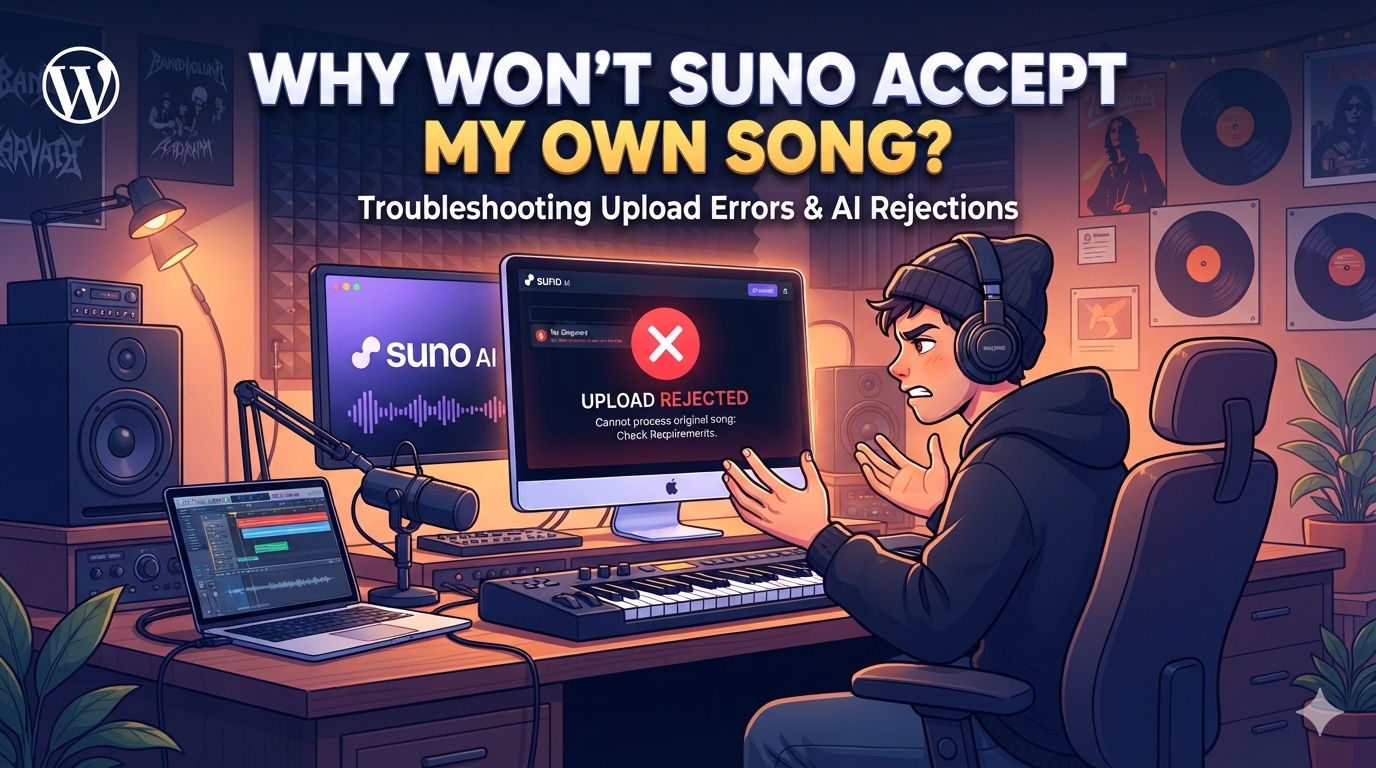
But often you upload a song you own asking Suno to extend it or flesh it out, and you get the “uploaded audio matches existing work” rejection. It’s not a bug.
Suno and Udio block uploads of any recognized recording, including ones you own. They compare every upload against catalogs of released and registered music. When you upload “Maybe I’m Amazed,” Suno can’t be sure you’re Paul McCartney working up a reggaeton version. They can’t distinguish the owner of a work from anyone else trying to reproduce it. Much too risky. So, that gate exists and isn’t coming down soon.
Let’s get you a usable result anyway.
Suno’s Cover, Extend, and Remix tools take audio as an input; music can be a prompt. These blocks don’t reflect what the model can do; it can totally do what you’re hoping. The blocks are a policy layer sitting on top that flips the switch upon recognition and refuses to get into questions of rights or your honesty. When the system’s fingerprint matching, lyric-transcription checking, or whatever else, flags your upload as a known, released, or registered work, it refuses.
We might as well sympathize. It’s quite rational.
The “uploaded audio matches existing work” message, explained
Suno hasn’t published how the gate works, so treat what follows as well-supported observation rather than a reading of their spec. Reports are consistent enough for government work: fingerprinting against a reference catalog, plus speech-to-text on the vocal checked against lyric databases. Either one will trip the breaker.
This explains the part that confuses people most. The system essentially asks whether the audio has been fingerprinted anywhere. An unreleased song, guitar and voice recorded at home or similar has never been fingerprinted, so it generally sails through. The song you wrote, recorded, and released years ago — maybe you posted it to Spotify — comes back “NOPE” exactly the way a chart-topping song or cover would, and gets stopped. Actual rights ownership never enters the chat.
Things we can understand follow from that, and inform our options. You are locked out of running your released master through Cover, Extend, and Remix type features. What’s barred there is the recording, not the underlying song. You might record it again, creating a fresh performance that has never been distributed anywhere, and carries no fingerprint, so the gate opens back up, and you are not locked out of all the cool Suno stuff anymore.
Alternatively, you can generate from a text prompt, which was never gated at all. But that’s not why we’re here. You knew that. You want the recording in there.
Which leaves an irony to contend with, and it’s frustrating. The more of your catalog you have put into the world, the less of these tools you can point at it. The songwriter with a drawer full of unreleased songs has full run of the joint.
But again, sympathy. The rejection someone gets when they try to have Suno flesh out their own recording is the same rejection an imagined not-in-good-faith user gets trying to leverage someone else’s work through the model. The system can’t tell those apart at the prompt layer, and whether it’s incentivized to build one, I haven’t considered yet…
but I can sure see why it’s the way it is now.
I got off the phone twenty minutes ago on this sort of thing, explaining the broad points to callers who assume it’s a solvable UX problem. It reflects the genuinely hard-to-follow bunch of litigation and cope out there. As of mid-2026, the recorded-music side of this “transition” has split three ways. Universal Music Group settled with Udio and is probably co-launching a licensed AI music platform with it. Warner Music Group settled with Udio and with Suno, the first major label to settle with Suno specifically. Sony Music Entertainment continues to litigate against both companies, and UMG continues to litigate against Suno. With me so far? All of it is around training, and whether training was “fair use” which is a specific argument in copyright litigation. Court is court and public opinon around what’s morally right or what’s good for music and for society is a whole parallel argument.
At any rate, the models are very much in court, so introducing some sort of “trust the uploader’s ownership claim” bypass feature today sounds to me like a terrible idea for innumerable reasons. And hey, I’m not a lawyer, but blocking on recognition rather than verifying rights is the legally stronger posture, even though it is a frustratingly blunt instrument that denies genuine owners a really cool feature set. All of which is to say again, this is not going to change while the Suno litigation is live, and probably not for a long while after they resolve. The settled labels, for example, have their own licensing economics to protect.
So what do you do
If the song that got blocked exists as a release, consider recording it again. A new performance, never uploaded to the platforms, carries no fingerprint and should upload fine. Although… the second check reads the vocal and compares the words against lyric databases, so a faithful re-record of a song whose lyrics were indexed may still get stopped. An instrumental pass glides past. Consider running some simple tests.
Of course you can keep the recognizable audio out of the upload entirely—describe the piece in text instead, generate from that, and bring human musicians in to re-record over what comes back. But yuck. You already wrote it, and what you want is the arrangement, realization, or performance.
It occurs to me, there’s a route I haven’t tried, and I’m going to test it myself. Suno’s Studio, which comes with the Premier tier, takes MIDI. Sheet music, no. I see nothing supporting notation import. But MIDI carries your actual notes, which text pretty much could not. So maybe you can put your unfortunately published song‘s note information in that way. My suspicion is that it will work and that MIDI import steps around the fingerprint gates that match recordings. A MIDI file contains no recording at all. If MIDI does walk past the gate though, what’s to stop me from playing in “Maybe I’m Amazed” note for note?
I’ll keep testing and come back to update this. If anyone wants to share their experience, by all means do.
Be a little careful always…
None of this by itself answers whether the “fleshed-out” result stays inside what you actually own. Elaborating your own composition with fuller instrumentation, a new arrangement, or a reharmonized backing track is not automatically safe just because the block came from AI. The AI stuff can’t be copyrighted (at present) but it can infringe. Musicologize is asked to do more originality clearance in the post-AI world than the pre-AI world. The same musicological analysis that informs copyright, sampling, interpolation, replays, and such still governs this too. If the AI-generated arrangement pulls in something protectable that isn’t yours, “the model wrote it” doesn’t matter much. Moreso because the model’s training data is, well, precisely what’s in dispute in the Suno and Udio cases. That’s why there’s preventative forensic musicology. If you’re concerned about infringing on another’s copyright, Musicologize provides originality clearance analysis and reports.
Wrap it up
The block isn’t personal. Don’t imagine it’s a glitch and certainly don’t be insulted. It isn’t really about ownership. It’s a recognition filter built to survive, or really prevent, litigation, which makes complete sense. The platforms treat every fingerprinted recording the same way. We’ve covered some workarounds and strategies, and we’re testing more.
Brian McBrearty is not an attorney; he’s an independent forensic musicologist. This is general information, not legal advice for your specific situation.
For pre-release clearance on an AI-assisted arrangement, an opinion on whether a “fleshed out” version stays inside what you own, or expert analysis where AI-generated material is at issue on either side of a dispute, Musicologize works with songwriters, independent labels, agencies, advertisers, and music attorneys nationwide.
- Email: brianmcbrearty@gmail.com
- Phone: (212) 217-9512
- Schedule a consultation: musicologize.com/contact
FAQ
Q: Why does Suno say my own song “matches an existing work of art”? A: Suno fingerprints uploaded audio and runs speech-to-text on vocals to match against known catalogs. The check flags anything that’s been fingerprinted anywhere, including your own commercially released track. It cannot verify ownership at the point of upload, so it blocks on recognition rather than the stickier matter of rights. It’s just too dicey otherwise.
Q: Will Suno accept an unreleased song’s audio? A: Generally yes. The check asks whether the audio has been fingerprinted anywhere, and a home recording that was never distributed hasn’t been. What gets stopped is your released catalog, which fingerprints like anyone else’s release does. Ownership never enters the discussion.
Q: Can I use MIDI or sheet music instead of audio? Maybe. Suno’s Studio, on the Premier tier, accepts MIDI. Sheet music, no; I have found nothing supporting notation import. Whether MIDI import steps around the fingerprint gate is undocumented, and I am testing it.
Q: Can I use my own music as the prompt for an AI music tool? It depends. Technically yes; Suno’s Cover, Extend, and Remix features accept audio as input. In practice, however, if the upload matches a known or fingerprinted recording, including one you own, it gets blocked. One practical workaround if your recording is fingerprinted is to record a fresh performance that has never been distributed and upload that instead.
Q: Why won’t Suno just let owners upload their own copyrighted work? Not incentivized at present. Suno and Udio are mid-litigation over questions around whether AI models can be prompted to reproduce recognizable copyrighted audio. Blocking all recognized audio, regardless of who uploads it, is the more defensible policy at least while that litigation is live, and possibly forever. The risk of the alternatives appear too great.
Q: Is an AI-fleshed-out arrangement of my own song safe to release? To a great extent, it should be, but be aware that the arrangement or other production the AI generates draws on its training data, itself the subject of litigation. AI generated music isn’t copyrightable, but it can violate another’s copyright. A pre-release originality clearance opinion is the standard way to ensure the output result stays inside protectable material you actually own.