

Olivia Rodrigo released her first original Christmas song, “take me home (4 christmas),” on November 5, 2026, and within days, talk spread that it plagiarized not one but two songs, one of which was another holiday track. Musicologically though, it won’t take long to cover both; neither amounts to much.
This song, by the way, is a BFG of cringe. And good for her. Anti-Christmasy has been known to work, as we’ll talk about shortly.
Step one: above the studio door you post a sign like:

Step two, if I’m in charge, is something like: Everyone switch instruments!
The first song people pointed to was “Christmas Wrapping,” a hit by The Waitresses in the early 80s, very familiar to any Gen X’er. And obviously, that’s valid. “Christmas Wrapping” is an evergreen we bop along with every winter when our standards go out the window and we simply have a wonderful Christmas time. I don’t see why we needed two of these though. The story goes that “Christmas Wrapping” came forth begrudgingly in the first place.
Before we delve further, let’s dispense with the observed similarity to “Candy” by Robbie Williams. It shares a recurring melody and groove with Rodrigo’s song and some point to curious resemblance in her outro. But let’s look real quickly at what’s up here:
Mind you, these comparisons spread as general chatter, not as a claim by anyone with a stake in either song. But stakeholders heard the scuttlebutt and have already made their thoughts known, less than a week later!
Williams posted to Instagram, saying Rodrigo may have “accidentally stumbled across a musical echo of mine.” But he was generally dismissive of the whole thing. He doesn’t want to know whether there’s a copyright issue (there isn’t) and isn’t going after her (nor should he be). He then distinguished himself on the whole, calling the habit of treating every familiar run of notes as a payday “ambulance chasing.” A near truism, but bully for him and his flowery “musical echo of mine” phrasing.
The musicology is literally kindergarten stuff.
The “Candy” observation is a zero. Mere similarity is everywhere in pop music, and this is some of the merest. Does it share a melodic figure? Yes, the observation is right. But a figure that old and that common belongs to no one, and it points to no single source. I do hope Williams enjoys the publicity.
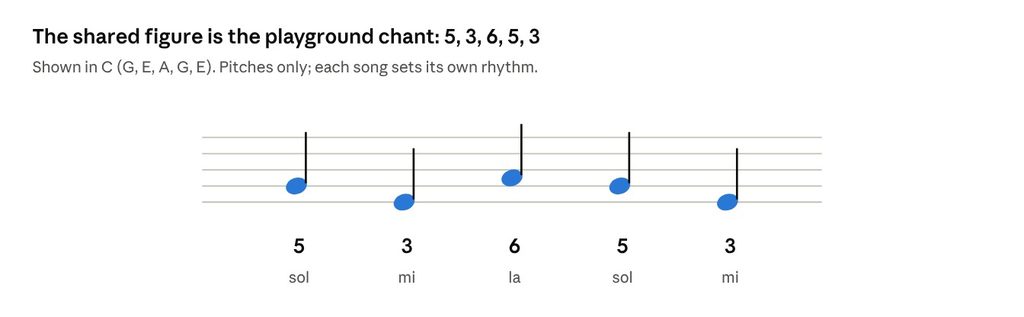
Williams acknowledges as much in “Candy” itself; the second verse opens by singing the rhyme’s own name to that melody. It’s “Ring Around the Rosie” — which, by the way, is probably not about the plague. This is the “merest” of similarities from a copyright perspective: a veritable public utility of a melody just this side of “Hot Cross Buns” and “Three Blind Mice.” Robbie is under none of the delusions of the “Rodrigo stole this from ‘Candy'” people.
Back to The Waitresses and “Christmas Wrapping”
The much more interesting similarities are to The Waitresses. Not from a forensic musicology vis-à-vis copyright perspective, mind you; there’s nary a similar note, but the blueprint is very much the same and as such, a decent lesson on where copyright stops and plagiarism arguably doesn’t.
Chris Butler wrote “Christmas Wrapping,” and he heard Rodrigo’s song before the rest of us did. She emailed him about it two months ahead of release. His verdict, posted under her video: “The vibe is there, but no plagiarism.” Butler has said a Christmas song was the last thing the band wanted. What he wrote, grudgingly, is about a woman who would rather skip the holiday altogether.
Anti-Christmas can work well, as can inspiration and imitation.
You don’t necessarily do it consciously. I’m not accusing anyone, and even if I were, I wouldn’t do it with any moral judgment. Yes, “Christmas Wrapping” sure seems to be the ancestor of “take me home (4 christmas).” But using an existing work’s premises, mood, groove, and, in this case, “wrapped,” talky, story-driven delivery does not equate to “copying” as copyright employs it. Rodrigo evidently takes a lot of inspiration from “Christmas Wrapping” but shares nothing protectable.
Imagine Rodrigo does absorb the blueprint as inspiration for her own inevitable holiday hit.
If you’re going to make a punky new Christmas tune, you need to do some punk things, like let a main riff or two be composed on a guitar by a novice guitar player — plausibly, but by no means necessarily done here.
“Christmas Wrapping” holds one bass note, A, pretty much throughout, while the chords above it slide around, like literally slide: A major, then D, then C, then B or Bsus, all over that same A in the bass. It sounds like someone grabbed a fifth (A and E) in the left hand and moved fifths around in the right. A+E, D+A, C+G and B+F#. That’s pretty much all you need to get through “Christmas Wrapping.” Punky. Functional, but nonconforming; sliding one interval shape around without worrying about staying in the key. No fear.
And while factors such as tempo and key are often reduced or minimized in their forensic importance around here, they’re not nothing. It cuts both ways. They’re still formulaic. If you want the same energy as an existing work, it won’t hurt to take its tempo and key. Rodrigo nearly did both. Both songs are in A, and hers runs only a little faster.
For better or worse, “take me home (4 christmas)” preserves all those Christmas Wrapping’s features. Stubbornly amateurish — a five-year-old with a new guitar on Christmas morning will find such musical figures — and that’s punk. The Waitresses came out of that world. Maybe you know their other hit. “I Know What Boys Like” reached No. 62 on the Billboard Hot 100 in 1982.
And things today are a bit punk too. I’m forced to see “take me home (4 christmas)” as fitting with a larger drift. Much of pop writing has been walking away from the chord logic that governed music for centuries, managing tension and its pull toward home. “take me home (4 christmas)” is irksome from the start with its bassline that moseys down sol-fa-mi, but mi is on a strong beat and isn’t going to develop toward a predominant, or toward vi, or frankly do anything else that’s good and just. Instead, it’s going to rebel and annoy me.
It just defies.
And scoreboard? Ugh, this will print money.
My daughters will be singing along to it at her concert in a month. Other scoreboard now…
Infringement? No. Copying? Not of anything that copyright protects. Plagiarism? That’s somewhat in the eye of the beholder. We’ll come back to it in a sec.
A lot of the work a forensic musicologist does is preventative originality clearance analysis. And if I were asked to clear “take me home (4 christmas)” because Rodrigo and co. were concerned that it nicks “Christmas Wrapping,” I’d have cleared it for sure. But there would also have been a discussion about calling Mr. Butler.
Is it wrong? Is it plagiarism?
Butler’s verdict is right about “the vibe,” and I wouldn’t hedge if he said, “the vibe is there, but no unlawful appropriation.” But nobody talks like that, and he said “plagiarism.”
As a forensic musicologist, plagiarism is not really my concern. Plagiarism is a somewhat different beast from infringement.
Infringement asks if Rodrigo took from “Christmas Wrapping” something that copyright law protects. But if “Christmas Wrapping” was steering the creation of “take me home (4 christmas),” if its authors took from it without saying so, there are plenty of people who would say, “there should be some acknowledgment of that.”
It ain’t a forensic musicologist’s call.
Plagiarism is a moral yardstick, so the verdicts vary by listener. Songwriters learn their craft by imitating someone, and every genre is a long chain of borrowing. If it weren’t, society would be hit with one intellectual exercise after another, instead of being able to enjoy new music in the first hearing. So where does honoring a model end and owing it something begin? A credit? A royalty? An email to the man who wrote the original, asking whether he’d like to hear it first? Rodrigo chose the email, and perhaps a “thank you” was said. Butler seemed to think it was enough.