

[updated 10/13/26]
Quoted in The New York Times, Oct. 14, 2026, on why so many listeners hear copying here: pattern recognition “leads people to see cause and effect and attribute to copying” what may be coincidence.
Stella Lefty has been very publicly accused of producing at least seven eight songs that plagiarize other songs. Two of her eight currently have songwriting credits to earlier writers; neither one a simple matter on their own. None of the seven produced an actual lawsuit, or a demand letter, or anyone publicly claiming to be a rights holder. And TikTok is chockablock with videos making a case that Lefty is a serial plagiarist. Copyright however is not in the repeat offender business. Grapeshot claims arise for some reason, but they fail — see that Marasco v. Taylor Swift shambles — but copyright is Song A v Song B.
Stella Lefty’s situation is admittedly special, and complicated. Fame and notoriety that many seem to believe are ill-gotten for a variety of reasons. Musicology isn’t concerned with that, though it’s fascinating.
What we can concern ourselves with is the music. Let’s find out if it’s fair, one comparison at a time. We can consider the serial plagiarist claim even if copyright won’t. At the end, we’ll have a scoreboard of sorts.
It’s what the people want, and I aim to please, so this is it: all the recordings in one place so you can listen along, and the musicological analysis to help clear up what we’re really hearing and what, if anything, the public, let alone copyright, should be up in arms about.
BTW, Stella Lefty Credited the Wrong Song
Two of the eight carry credits to earlier writers — one of them, to the writers of The Chicks’ “There’s Your Trouble,” while “Misery” carries none. Not yet, at least. I’m going to have a problem with that.
But first, a bit of framing
When I examine an actual claim, or even a prospective claim, a forensic musicologist’s role is to illuminate the musical facts that would help a court render an infringement judgment. The court makes that judgment, whereas a forensic musicologist provides the insights that inform it. Most claims never go before a jury, or even very deep into litigation before some sort of resolution, but the work is premised on serving that process however far it might go. I look at what’s shared between the works, how common the shared material is, and whether the degree and specificity of the similarity supports an inference of copying and then, well, how bad?
Song by song, here goes:
1. “Boston” and Noah Kahan’s “Stick Season”
This is the one that gets us rolling, right?
I don’t wonder that you’ll hear the similarity. I barely wonder if anyone here doesn’t know both by heart.
Let’s go! What have we got here?
Probably no point in burying the lede, right? It’s a good bit alike, but not strikingly so. How can that be?!
Especially since we go into this knowing the two are supposed to sound alike, we hear it from the jump. Stella introduces Boston by stating her chorus hook over sparse accompaniment. And even though Noah’s chorus won’t come around for a bit, his verses use the same device: not the same notes, but the same shape. The device is a two-measure phrase characterized by stasis for almost seven beats, then comes that thing we all hear: the upper neighbor note on the and of two.
And then the next device is to repeat it in the second line of the stanza, new words, same tune. If we’re looking at the form within the verse, the first line we’ll call A. And the second one, same melody but new words, we’ll call that A′. Depart from it in the third line — we call that B — then the songwriter might choose between returning to the original idea, presenting a third before you repeat the whole thing, or letting it all collapse in the last measure before you start it up again. He takes the first, she the third pretty much. So he’s A A′ B B′, and she’s A A′ B and out. Songwriting needn’t be so formulaic, but what I just described is tried and true, and nobody owns it. It’s something both of these tunes do, but the idea of repeating the first melody with a new lyric is first “an idea” and second, a common device. Copyright doesn’t protect ideas or commonplaces.
There will be more of that.
How about the chords? Both play four chords over and over for most of the song. Anyone with a little guitar or piano training from childhood can play either. Lefty loops I–ii–IV–I, two bars per chord. Let’s say we’re in the key of C, in fact, we’ll agree to say that all the way to the bottom of this page.
In the key of C, those roman numerals I–ii–IV–I represent C-Dm-F-C. That’ll get you most of the way through Boston. Its shape starts at the “home base” tonic chord, followed by the soft subdominant ii, then by a full-strength subdominant IV, then a plagal (soft option again) cadence back to tonic. Noah’s chords are not only completely different, but he happens to be running with I–V–vi–IV, or C-G-Am-F, which everyone with a phone recognizes as the good ol’ Axis of Awesome chords.
There are some similarities in the form, like the shortened second verses; Kahan halves his second verse; Lefty cuts hers to twelve bars. But a shortened second verse is a common, efficient device that moves the form along. And the forms aren’t the same on the whole.
We might also notice similar functions in the chord progressions. They use plagal cadences; they return to their tonic chords via IV rather than the expected, so-called “authentic” cadence that would precede the I with a V. In fact, both could be said to hold V chords in reserve until they really want them. Lefty uses hers at the end of that shortened second verse. It helps her second chorus arrive with some punch. Kahan’s comes in bar 16 of his choruses, and this is rather the opposite tactic, at the foot of his arc, removing the energy so he can initiate it again returning to his starting idea, his intro. Same chord, similarly held in reserve, with opposite jobs.
THE MELODIES THO
As to the melodies: Again, say both songs are in the key of C, so I don’t have to reach for sharps or flats. Allowing for some variations, let’s say Kahan’s chorus opens G G G G E G E G E A E G, and Lefty’s opens G G G E C G E G E G A E G. That’s 12 and 13 notes over a couple of measures and a whole lot of Sol. And more stasis, Do-Re-Mi-Fa-Sol-La might be all we need to get through both of these entire tunes. Pianists learning these melodies need not move their R.H.’s, ever. And their pinkies are gonna get worn out. Sol is held mostly throughout, broken up by a mi or a do when it gets to be just too much sol. (yes, I’m gonna keep doing that) AND THEN, “la mi sol.” That’s her “gun and I’m” and his “sticks and I.” That’s the foremost similarity everyone hears; after all that sol, you get the ends of those two phrases, EGEAEG and GEGAEG, and it’s real, but is it infringing? Is it plagiarism? Why’d I ask the two separately? We’ll get there.
The lyrics are obviously different; with Kahan playing rhyme games mid-phrase sometimes, nicely, two rhymes within a line; Lefty rhymes couplets around a refrain, more standard stuff. The chords are different. The melody notes’ rhythmic placements are different.
A quick step back
Here, we’re taking a rapid-fire look across a big collection of song pairs. And we aren’t about conclusions, we’re about evaluating evidence. It might help to do a quick overview of some of the calculus we have time to consider. All of these similarities and differences we’re identifying in Boston and Stick Season, and the others soon, are factors and values. Here, the chords are different, but not light years apart. The rhythms differ, but not light-years there either. The strength of each difference is weighed against melodic similarity, which has its own factors, like degree, specificity, and conventionality. My approach to forensic musicology is relatable to statistics and probabilistic calculation, and, if I’ve had enough sleep, critical thinking.
This isn’t my first look at Boston and Stick Season. I gave this pair a listen in September. The similarity is plain. But my initial finding cut to a clarifying thought: that Boston did not require “Stick Season” as inspiration, much less source material. Lefty said she didn’t have Stick Season or anything else in mind, and the notes themselves do not allow a confident inference otherwise. The commonplace elements they share leave the probability of coincidence too great. Meanwhile, even if she did hear and admire “Stick Season,” the commonplace elements they share are not monopolizable by “Stick Season.” So to a point, Lefty can have Stick Season, and a dozen other songs she admires, in her head as inspiration for Boston, and inspiration is something copyright allows. Whether the shared material is protectable is a separate question, and it is the one that matters most.
That still leaves a lot of circumstances that social media is busy sorting through. My analysis wouldn’t binarily deny Lefty’s denial — she has said she was not consciously thinking about his song when she wrote hers. My analysis isn’t concerned that “Stick Season” was a hit only a short time ago, or that old clips of her covering “Stick Season” surfaced. Public opinion may still be very much concerned. And now we’re someplace distinct. The terms “infringement” and “plagiarism” are used almost interchangeably, but infringement is a legal finding, and plagiarism is rather a moral one; neither is a musicological one. As we look through the rest of these, consider them in parallel but distinctively.
And note: Kahan is credited on Boston now, and this never became a legal dispute. I’m not mad about it. Moving on.
2. “Summer You Were Mine” and The Chicks’ “There’s Your Trouble”
This one is going to be an issue. I’m going to make an issue of it.
If the rest are this easy, we’ll be outta here in a jiff.
The main similarity here is a shared but unprotectable chord progression. Think of them as peppy versions of what you hear in “A Whiter Shade of Pale” or Bach’s “Air (on a G string),” or maybe Pachelbel’s “Canon” or Piano Man, or Can’t Help Falling in Love, or ummm… Tears In Heaven… or… this:
Before anyone points out that these aren’t all identical, who cares? The whole thing, in a handful of variations, is so stock — descending stepwise scale in the bass supporting chords I–V–vi–iii–IV–I–ii–V or something not far from those. Are the grooves a bit similar? Yeah, but they’re stock too. Not identical. And relative to their ubiquity, tiny factors in our calculus. The lyrics are obviously different, and the melody is similar only in a painfully general arc sense. And that arc?
Supposedly, this is a licensed interpolation?! Wikipedia says so, “Lefty’s song… interpolates The Chicks’ ‘There’s Your Trouble.'” Rolling Stone reported in late August that it reviewed materials showing Lefty’s team cleared the track with Sony Publishing and that Tia Sillers and Mark Selby appear as writers for Summer, and something about how a streaming platform error briefly left their names off?? Sillers told Rolling Stone she hopes listeners will learn “that it’s an interpolation of ‘There’s Your Trouble.'” I have listened, and nobody should learn that from this. They should learn something else.
Arguably, certainly, if the writers of “Summer You Were Mine” say it’s an interpolation — they’re the ones who took out the license and put the Chicks’ writers on the credit — that makes it a fact. But what if a license only tells you somebody thought a license was a good idea? Even if the writers went further and said they were trying to channel the Chicks, that would tell me what they were after, more than what they got. The result is a song that was influenced by another song, which describes most songs and a ton of “I didn’t copy” arguments. If “Summer You Were Mine” sits no closer to “There’s Your Trouble” than it does to a few other songs built on the same descending bass and the same chain of chords, then it borrowed from the common stock, and Sillers and Selby have no more claim to that than Pachelbel does. That doesn’t mean they should reject the credit.
An interpolation is a recognizable, non-trivial piece of one composition deliberately placed inside another. It’s a quote. The whole aura of the older work rides in with it. While we’re at it, it’s not a sample. The piece comes from the song, not the recording; using the recording is a sample. It’s recognizable such that a listener who knows the source can point to where it appears. Eighteenth-century singers inserted favorite arias into whatever opera they were performing. Tin Pan Alley called an outside writer’s song dropped into a Broadway score an interpolated number. In the sampling era it became a licensing matter, a practical tactic: sing a piece of an earlier composition instead of sampling the master. Tchaikovsky puts “La Marseillaise” into the 1812 Overture. Holst threads “Greensleeves” through his Second Suite. “Ghetto Supastar” takes its whole chorus from “Islands in the Stream.”
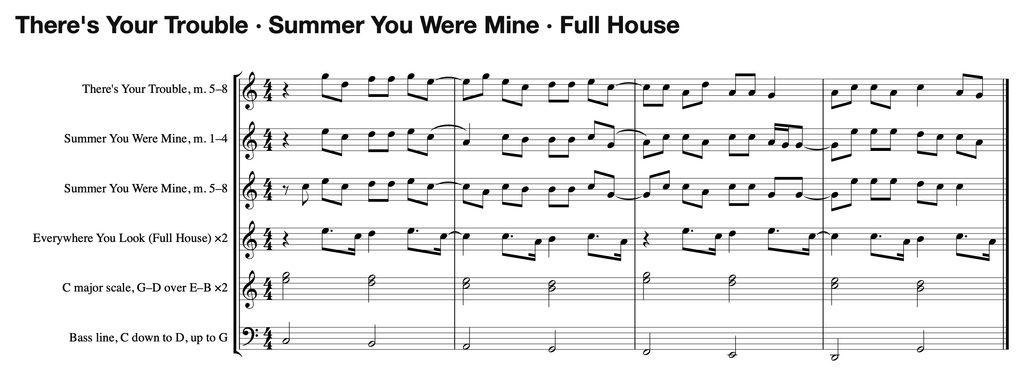
Here, what is shared is the descending bass with its stock chain of chords, a melody that follows the bass down. That is the inventory. A descending bass under I, V, vi, iii, IV, I, ii, V is not Sillers and Selby’s, and a melody that walks down with it is not theirs either. So, show me. Point to the bar where “There’s Your Trouble” shows up in “Summer You Were Mine” the way “Islands in the Stream” shows up in “Ghetto Supastar.” Show me how it’s not pretty much just sequencing your way down the major scale from G or from E as I show above in the fourth staff.
Even if you don’t read music. Look up at the notes. The second measure of There’s Your Trouble looks a lot like the first measure of Summer You Were Mine. Does Summer not look just as much like the theme from Full House with a couple fewer syllables in its lyric? Of course it does.
One pattern that is developing
These songs sound like everything. One competently employed device after another. That’s not derogatory. Not when I offer it, at least. Todd Rundgren made the news recently, inexplicably giving Taylor Swift an overly hard time, calling her the apotheosis of mediocrity. He may not be entirely wrong that it’s milquetoast, but I disagree about the judgment. Genius is great, but it’s rare. In the meantime, songcraft isn’t easy either, and it’s a gift to society. And Swift has written bad, okay, good, and very good songs. I like both of these songs. I find something to like in every song on this list. Even “formulaic” isn’t a slight when I say it.
I’m therefore inclined to pose the not derogatory hypothetical: My friend has fifteen song ideas with lyrics framed out, and a very expensive week booked at Abbey Road Studios in the hopes of getting a whole record done and dusted (as they say in Abbey Road land). Would it be immoral of me, as producer, to recommend he consider the energy shape of the whole record and perhaps use existing songs he admires to illustrate that shape?
How about a real-life example: Was it morally wrong of Robin Thicke to say to Pharrell Williams, “Damn, we should make something like that, something with that groove” regarding Marvin Gaye’s “Got to Give It Up?” That idea gave them and us the hit “Blurred Lines” and a fiasco. But not only was it not wrong of him, it was awesome of him. I sit at a piano and write something like something else every week.
3. “Why Wouldn’t We” and Blake Shelton’s “I’ll Name the Dogs”
I might as well stress this, it’s not as though I don’t get the point. Of course I hear the similarity! And similarity, even where it’s obvious, by itself is not infringement. It really isn’t.
If I write out these melodies and chords, even without being able to read music, the notes will be plainly different, and the harmonic progressions will be as well. There will not be expressions shared across these two songs. What everyone is hearing is real, but it’s at a much more general level than the one a forensic musicologist is usually concerned with — substantial similarity, it’s often termed, where “substantiality” is a value that supports cause and effect, copying, and then degree and specificity in the similarities that copyright is concerned with as a wrongdoing. Here, the value is modest and insubstantial.
As for where this stands, I think we’re at no credit and nothing from either camp.
On social media, clips pair the melodies and also the lyric premise: a couple dividing up the household as the relationship changes.
Premises are not protected by copyright. The expression of a premise is.
4. “Misery” and “A Million Dreams” from The Greatest Showman
As you’re listening to “Misery,” were you thinking, “hey, there’s that structure from Boston and Stick Season; the AA’BB’ thing?”
Doesn’t matter, that’s not the point anyway. Duh. The choruses.
Guess what? I’ll be expecting a credit here, in no small part because it’s starting to look like a practical move, consideration but not admission, and compared to the others? Shouldn’t we develop a “degree of similarity/likelihood of credit” ratio as a predictive mechanism?
Are the melodies identical? No. Are the chords identical? No. Are they both close? Yes. Closer than I can easily brush aside? Yes. And taken as a whole, what dissuades me? Where are the differences that inoculate? I consider them, and I’m not persuaded away from that this is closer than I’d have cleared, and for a great many reasons. Substantial similarity is a value, fluid. It leads to a binary finding that’s not a forensic musicologist’s finding, but a court’s finding.
In a quick transcription, I show identical pitches at identical rhythmic values in red. These melodies might vary a bit in a couple of repeats throughout the songs; I just grabbed the first ones. It looks like it sounds; alike. The structure in here: the choruses are seven lines: three, three more, and a tag in the last couple of measures. Mentally nudge the last measures this way or that, even if you don’t read music; you’ll see the shape and why I show them in red even though they’re offset.
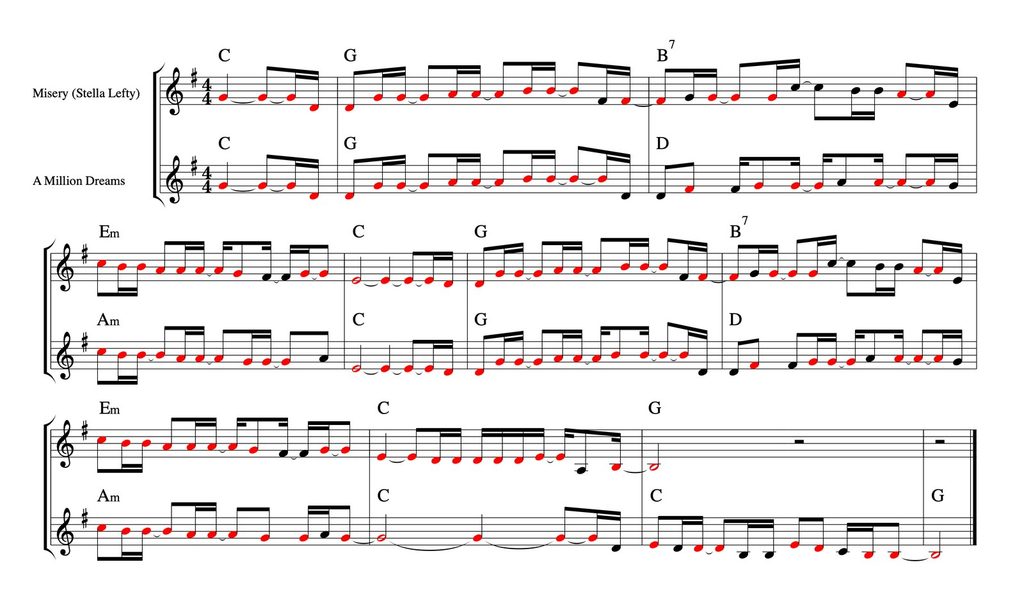
Don’t imagine that musicological analysis, done well, merely counts the red notes. Some notes count more than others, some hardly at all, and some notes are shades of pink. This pairing is obviously pretty red. And while Misery’s B7-Em isn’t the same as Millions’ D-Am, as differences go, they do relatively little in terms of redefining and distinguishing these apart.
Comparisons to A Million Dreams are quite valid. Start the clock.
5. “seven eleven” and Wheatus’s “Teenage Dirtbag”
Nah.
By now you might be recognizing it too. When Stella sings her first two lines, it’s just those initial four notes, Mi-Fa-Sol-Ti, repeated with different lyrics, A and A’. It’s something she does over and over across this collection. And so does everyone else. As for the four notes themselves, they’re the same alright. But it’s four notes, the first three are a scale fragment, Mi-Fa-Sol, and then the skip up to Ti. Just four, and the rhythmic placement is close but different. It’s not a lot and it’s not exactly alike, and it’s not compelling.
6. “Something to Lose” and Jason Isbell’s “Children of Children”
I only got through the first 30 seconds before I jumped beneath the video to type this thought: “This is gonna be about that chord progression, right?” And truthfully, if it’s not that, I’ll delete this and move on. But when it is that, I’m going to say, “Yeah, you don’t hear that I to v chord progression that much in popular music, though you do hear it. Fire and Rain by James Taylor? Main Street by Bob Seger? Kokomo by the Beach Boys!!” There’d need to be quite a bit more than that. Let’s see.
Well, it is that. In fact it doesn’t go any further than those two chords before even the mere chord progressions deviate.
Jason plays I-v-ii-I and Stella plays I-v-IV-IV.
Am I surprised that once the idea that Stella’s songs are derivative by nature gets momentum, lesser similarities are going to get more attention than they merit? Quite the opposite. This was what I imagined as soon as I heard Stella’s second chord. It was a guess, but it wasn’t wrong.
Moving on.
7. “Good at Leaving” and Justin Bieber’s “Ghost”
These are getting predictably thinner. I admit I had a thesis going in. I’ll get to it.
Here though, again, same chords. Tired of roman numerals? Sorry… This is vi-IV-I-V in both cases and a zillion others. And honestly other than that, I wasn’t really struck by anything, so a hammer looking for a nail might find anything that supports the presumption. I’m in the business of keeping my logic going in the opposite direction — start with the evidence, then form the thesis.
8. “Badly” and Shaylen and TAELA’s “WATCH THIS”
Stella Lefty played an unreleased song called “Badly” at the Bluebird Cafe in Nashville on October 1. In the audience was Audrey Gibbs, music reporter for The Tennessean, who posted a phone video of it. There is no studio recording, so the phone clip is all anyone is comparing.
And within a couple of days, a “Song B” emerged!
And this time the accusation does come from Song B’s artists. Shaylen and TAELA released “WATCH THIS” in 2024. TAELA posted the two side by side on TikTok. They say the vocal melody, phrasing, and cadence are effectively the same and that the claim is not about the chords or the genre. And indeed, parts of the melody are similar. But the claim couldn’t be about the chords or the genre, because the chords are different and nobody can claim a genre. Perhaps they realize both.
And once more, we can certainly hear what they hear. It’s this.

What I’m showing are eight contiguous bars of Badly. Just the first time she sings the figure. When she repeats later — it’s in the video which is only a part of Badly — it’s considerably different and less relevant. And then I’m showing four and then another non-contiguous four from Watch This; the purported similarity in its strongest light.
Plainly, your eyes and ears can see the chain of C’s and then the jump to E, and again if not as rhythmically similar in the second measure. And then B’s to D’s in the third with a more scalewise melody in the fourth. All of these are indeed similarities.
But the melodies aren’t very original. I’m not saying the works aren’t. I’m saying it’s a very common idea to take thirds from the scale and sequence them up and down. In both cases, a lot of “do-do-do’s” and a “mi,” then some stuff and the same idea a step lower, a bunch of “ti’s” and then a “re.” “Watch This” then does the most expected next thing — nothing wrong with that in the least, mind you; it’s probably what Suno would do — another step down and an idea around “la” and “do,” that we’re not showing.
Prosody describes the way a melody and its rhythm accommodate a lyric. It’s broader than that, but that’s the part that serves us here. And if you want to fit that many syllables in, and allocate their energy meaningfully and musically, there are only so many ways to get them into a measure. I’m finding that Stella Lefty songs get a lot of syllables into small spaces; it’s one of her styles, evidently.
But this is another ratio situation where the material in Watch This that’s shared in Badly factors out thusly: not very protectable, not very identical, slightly different harmony (It doesn’t matter that they point out the harmony isn’t part of their claim, it’s still a factor); the lyrics aren’t similar, and there are differences in and around these commonplace similarities. Another minor mitigating factor: in the repeats, Lefty changes this section up quite a bit. This is simple melody writing, outlining her IVmaj7 chord, which is in itself a different expression from the steadfast one over a tonic chord in Watch This.
Similarity that’s also commonplace often, as here, nets out to not enough to infer copying, nor enough to amount to substantial similarity.
[updated 10/13, and I can’t believe I have to update the scoreboard already. But since the accusers seem to have been so pleasant, let me share their whole track.]
But it’s 6 of something and then the something two scale tones above it. We don’t protect that. The Ohio Express didn’t sue The Cars.
Plagiarism. Infringement. Theft. Copying. Interpolations. Social Media.
Those words mean things. They’re not interchangeable.
The overview is this. These similarities are clear enough, but they’re among commonalities of composition. Music is language. Bach was a long time ago, as was Shakespeare. I referred to Bach in my Summer You Were Mine thoughts, and shoehorned a Romeo and Juliet expression only a day or two ago talking about a claim on an Olivia Dean song. Sometimes we refer to conventional elements and choices in songwriting, especially popular songwriting, as the “building blocks” from which popular music is erected. Two houses might look a bit alike, but if the architecture is conventional, alike is somewhat to be expected and desirable. The originality lies elsewhere. The door pretty much goes where it does. The walls need to hold the roof up. Too much originality and nobody is going to want to live there. I could milk the metaphor further, but the point is we don’t want too much novelty in our popular music. Along with a degree of cleverness and sparks of originality, we want a foundation (sorry) of things we can understand.
The analysis and calculations need to make sense in both directions. When I’m hired by artists and brands to check music before it’s released or before it’s in a series or a commercial, it may be that there’s a concern already in their minds; perhaps there was a creative brief that included prior work as direction; other times someone listened and presented a concern. The question I’m answering is the same one either way: what is shared, how common is it, and does the degree and specificity support an inference of copying. Before release, ‘too close’ can get a rewrite. After release, increasingly it’s a credit. I’ve written before that credits get handed out where the musicology finds them needless, but they can justify themselves on other grounds. A credit is the lesser evil next to the courts, and it quiets the public furor. Every pair in this article would have been a reasonable candidate for a clearance opinion, and on most of them the opinion would have been short. On a couple of them, it would have come with suggestions.
But keep your reasoning clear. Copyright infringement requires copying and copying requires “access.” And you can’t copy what you’ve never heard. Similarity then would be coincidental, and that’s pretty much the opposite of infringement. These “song B’s” are all known. It would be hard to dismiss access, but access can’t make up for weak similarity; that’s the inverse ratio rule, and it’s gone. Commonplace material is nobody’s to own, and similarity in commonplace material points to no one source.
I had to learn that Lefty is Stella Lefkofsky. Her father co-founded Groupon. If the nepotism argument and the industry-plant argument arrived before most of the song comparisons did, then they may explain this humiliation storm better than the music does. A frame like that invites confirmation bias, and once a listener is primed to hear theft, ordinary similarity finds them. It’s somewhat inescapable; I came to each of these pairs already knowing something was supposed to sound similar. In practice, I strive to avoid even knowing the thesis ahead of the evidence. It’s not always possible. Then you rely upon discipline. Here, I’m at least unburdened by the specific findings the public has made; I went to the music first. As I learn of them, I’ll return to explain their viability.
I haven’t seen it, but I might expect that when she offers credit, arguably in response to the public outrage, some might then see that as another sin, a payoff. But consider its prompting. If the accusation was at best overblown and at worst ignorance, it’s not an unfounded response. It’s consistent with any sort of nuisance settlement. In principle, I despise those. But as a weighted business consideration, refusing one would be stubbornly impractical.
We want inspired music. Music exists to be enjoyed, and new music built from expression we have already internalized is artful language. Learning music is learning a language we use to tell musical stories. If a songwriter’s language and story are straight from Mars, fewer people will enjoy them. The shared vocabulary that makes these comparison videos possible is the same vocabulary that made “Boston” a hit. Popular songwriting is formulaic by design, and how much derivation you tolerate is a matter of taste. The law tolerates quite a bit, on purpose, because the alternative is having to look for a front door to a house!
Hopefully this helps. Similarity gets far more attention from the public than from a forensic musicologist. I consider the question of degree, of cause, of effect, and then of culpability. The crowd tolerates less and doesn’t fully appreciate how prevalent convention is in pop music. The public far too readily attributes short or otherwise minor similarity to copying. Pattern recognition kicks in. It quickly rises to a threshold too conspicuous to forgive.
Most of the noise around Stella Lefty comes from this.
Oh, I promised a scoreboard. Google will make quick work of this, thank goodness. Since I’ve been publicly irked by credits being given out too easily, even while I’m trying to be understanding about it as a practical step, here’s our scoreboard. And as you can see there’s some game left.

Related: Did Olivia Rodrigo Copy “Christmas Wrapping” or “Candy”?