
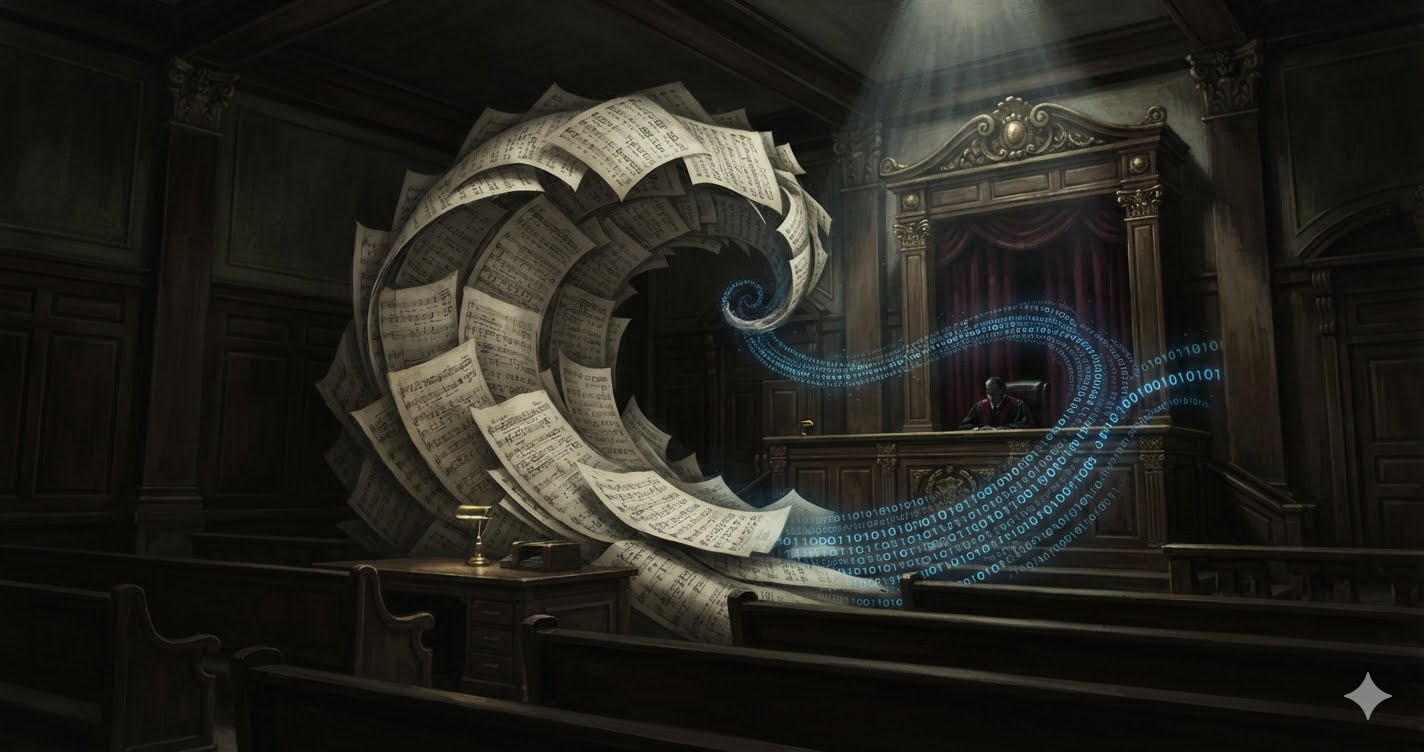

On July 31, a Munich courtroom is expected to do something no American court has done yet: hand down a verdict on whether an AI music generator infringed the songs it trained on.
The case is GEMA v. Suno.
GEMA, for American readers, is roughly Germany’s ASCAP and BMI rolled into one, and it sued Suno in January 2025 over songs we know: “Forever Young,” “Mambo No. 5,” “Daddy Cool,” “Rasputin,” “Big in Japan,” and one we don’t know unless we’re German, and in Germany, where, trust me, it’s huge.
Here, both sides already agree the songs were used in training! We’re past that. In the American Suno cases, the parties went years deep fighting about what went into the training set and how it got there, until Universal and Warner settled. Sony fights on. In court, with huge numbers involved, that matters to the record companies and to Suno, both of whom wanna go on making money and clobbering humanmade music. They’re not interested in what you are. They aren’t going to tell you what’s good and bad and right and wrong. And whether AI is Theft, Plain and Simple, or whatever other distillation will satisfy the rampant indignation. If you want to know “what’s legal and what’s not?!” stay tuned to Munich, where Suno got the songs from YouTube, (duh, where would YOU get em?!) and nobody is disputing the ingestion.
Musicologize readers are familiar with my three-legged stool of copyright infringement: access, similarity, protectability. Infringement requires copying protected expression and then significantly appropriating it in a new work. You can’t copy what you’ve never heard, and that’s “access” in a nutshell. A forensic musicologist can establish an inference of access if two works’ similarity isn’t attributable to coincidence. So it’s rather… convolved? (is that the word? convolved? intertwined? entangled?) But in Munich, the access leg is conceded, and we’re just moving on; for the time being way more interesting to me than the major record company cases.
So where did the incriminating outputs come from? GEMA made them. This matters, not in a good way; in a familiar way. Maybe you’ve seen this. It’s silly as presented but serves its purpose in court, and I’d concede in the court of public opinion to the extent the algorithm serves up the gullible on a plate.
The collecting society apparently sat down with Suno’s generator and prompted each of the six songs the way a plaintiff might: original lyrics, style, title. If that sounds familiar, it’s the same move the American record companies used; prompt the machine into reciting, then wave the recitation at the court as proof of training. So you can stuff the prompt until you get the desired output, and that serves the training argument, which is where those cases live – establishing access and training without license which you can then argue is copying and not a fair use. It also demonstrates the potential for copying.
All of which, I’d expect, gets you to settlement, probably without ever arriving at a finding or a precedent regarding LLM training. Fine for them. Unsatisfying for musicians and musicologists.
Then there’s this video going around:
This video has around a million views and counting. It’s a British producer named Louis La Roche who appears to type a prompt into Suno and get “Johnny B. Goode” back. It’s misleading, and it doesn’t prove what he thinks it proves. Down in a pinned comment on the Facebook version, La Roche concedes the recording is a 2024 exhibit from Universal’s lawsuit, and I wouldn’t presume to know how they framed it. But here, the comment is “if you put the same prompt in Suno today, it’s going to give you a different generation every time.” The demonstration was a replay. La Roche, meanwhile, admittedly has a grievance. He says 131 of his songs sit in the scraped training datasets, and I don’t doubt it. That’s the access leg again. Conceded by pretty much everybody, everywhere. His fallback, in the same comment, is that if you generate enough times, something recognizable eventually falls out. Maybe so. But first, show me and show the misled million-plus. And second, so what? “Recognizable” isn’t the bar; substantial similarity is a different standard.
But look at what GEMA apparently left out in its prompt. No melody. No rhythm. No harmony. No arrangement. And per the hearing reports, the melodies came back anyway. For the lyrics, the experiment appears to me circular. For the tune, it isn’t. Nobody handed the model the tune, so wherever the tune came from, it was not the prompt. However…
I haven’t heard the output. Let’s say it’s Forever Young verbatim, or at least closer than Suno has a right to generate and license. What do we learn? We learn we’re right that the outputs might always plausibly infringe upon existing works, as any other new work might plausibly do. That’s why we have originality clearance analysis.
Alternatively, let’s say I analyze it to be insignificantly similar to Forever Young – I label their observations as generic gestures at style, for example. Then it’s got no teeth; I’d just say, “you insisted on producing infringing lyrical similarity, which is fine, and stapled it to an insignificant or contrived musical one. Not fine.”
Suno’s answer, per the same reports, stacks that the German court has no jurisdiction, US fair use covers it, the songs are “not recognizable” in the outputs, the model stores mathematical patterns rather than the works, and anyway the outputs belong to the users who prompted them. Every bit of which makes sense to me, except the last one. Blaming the prompter comes back in a moment.
So, noting that I’m not a lawyer, much less a German one, GEMA isn’t only using the outputs to prove training. It pleads the outputs themselves as infringements, unauthorized reproduction, and making available to the public, with damages attached. In the American suits, the output demos are scaffolding for a training fight, where fair use is the battleground. Germany has no fair use. The battleground is a text-and-data-mining exception, and that’s another thing: this same chamber already ruled on it, against OpenAI, last November. It held that text-and-data-mining is about analysis, not a model that can regurgitate whole works, and that the provider, not the prompting user, answers for the output.
That would be something. In Germany at least. Here we have this “transformational” factor! (but again, I’m not a lawyer.)
So, blame-the-prompter has already lost once in this courtroom. I won’t handicap whether it loses twice. What I can tell you is what the ruling will and won’t tell us regardless of who wins.
If GEMA wins, it establishes something significant around the legality of training without license in the EU but nothing especially impactful about US cases.
But the output-similarity findings, if the court makes any (I’ll eat my hat), become the first judicial treatment of AI musical memorization and regurgitation anywhere (I’ll buy another hat and eat that too).
If Suno wins, the TDM question got answered the other way which potentially provides some guiding logic in the US, and the musicological question likely survives untouched along with my chapeaus.
One more thing worth saying before the verdict rather than after. Whatever Munich decides, the question American courts will eventually face is the one I keep writing about across the Suno cases: when an AI output resembles a real song, is what’s shared protectable expression or the common vocabulary copyright leaves free for everyone? That’s unavoidable. It’s gonna be someone’s liability – the user and their licensee’s almost certainly, and the Udios and Sunos probably.
Unless they’re somehow inoculated by whatever settlements come out of the domestic suits. I should’ve been a lawyer.
It’s something to look forward to. The German verdict won’t answer the Ninth Circuit’s issues, but if the Munich court engaged with the output evidence at all, its reasoning will be the first data point on how a judge thought about it. I’m looking forward to it on the 31st.
For now, ahead of the ruling, that’s all we’ve got.
Come back in a week, and we’ll grade the court together.
Friendly arguments welcome.