

Called it Update · November 6, 2026
Ed Sheeran settled this lawsuit in April 2017.
In July 2016 I wrote, “Sheeran should settle this.” How it went ↓
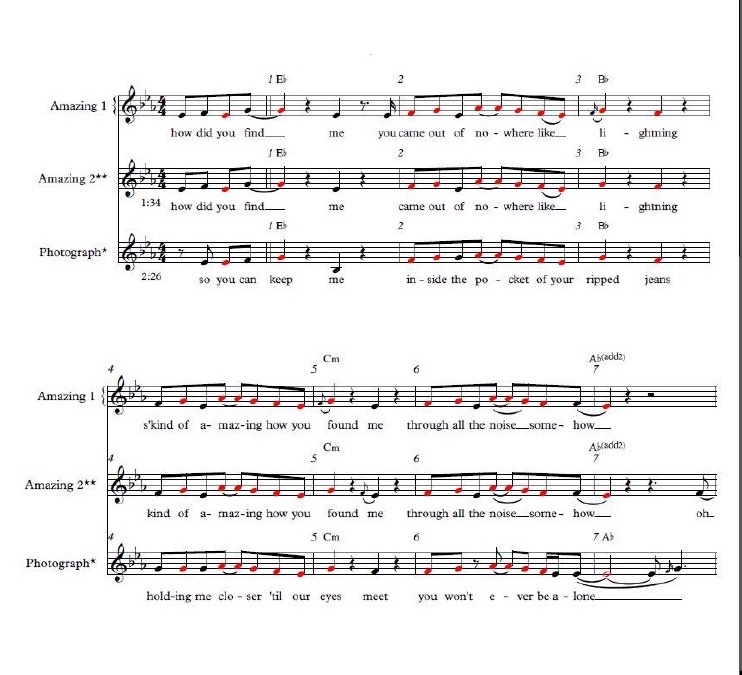 I would argue that there is only ONE high value note that’s different in the two choruses. Which is it? Can you guess?

It’s the quarter note on the third beat of the chorus’s first measure (not the pickup measure, the next one, labeled “5.”) The lyric is “me.” There’s little refuge for the defense in this critical note being a different pitch. Harmonically and melodically “Photograph’s” fifth scale degree here is THE MOST CLOSELY RELATED DIFFERENT PITCH AVAILABLE compared to “Amazing’s” third scale degree. This is where musicology really shines. Musical notes are not simply “alike” or “not alike.” Notes are like colors. They can be complementary or analogous. Notes are like language. They can be synonymous or antonymous. Here, of the eleven other notes that exist, Sheehan’s note is least different of the eleven non-identical possibilities.
But the way, this note is a high value note because of its location in the chorus and because of its lyrical, rhythmic and cadential treatment. It’s emphasized in every musical way. It’s actually one of the two highest value notes in the whole track – not identical, but as close as it gets.
This next one is almost humorous. Perhaps it’s in the boilerplate.
Both the “Amazing” chorus, and the infringing “Photograph” chorus, utilize similar structures (both have verses followed by bridge and chorus sections), and the first chorus of each song is half as long as the chorus sections that follow.
What?! No way!! In a pop tune, you say?? That’s true of nearly every pop tune, people.
The chorus of “Photograph” is 41% of Photograph.
This is similar to their “the chorus is important” point. But it’s interesting because this isn’t really a part of the “they stole our song” argument. It’s really setting up the damages calculation. They’re will argue that they’re entitled to up to 41% ownership of Sheeran’s track. They’ll further argue that it actually should have a multiplier applied because it’s the hook. “The chorus is important,” they said. But for now, they’re getting it out there that it’s at least 41% of the notes on paper.
The chord progressions are essentially the same. There’s one chord that’s different, and it’s not very different.
True, they’re the same as one another. They’re also the same as a great many other famous pop songs. In fact it might the most common progression in modern popular music. And as with the red and black notes of the melody, the single not-quite-red chord in the progression (imagine that in your head, because we don’t have a graphic) is not very different at all. Here again we will describe how chords, like notes, can be analogous. The chord in “Photograph” is what we call a “V” (five) chord. “Amazing’s” is a “iii” (three) chord. The upper case roman numeral denotes “major” chords, and the lower case denotes “minor” chords. These two have more common pitches than distinct ones and function similarly in the progression. They’re very analogous.
We often hear it said during these copyright lawsuits, “You can’t copyright a chord progression!” and no, indeed you can’t. But chord progressions are harmony in motion, and combinations of melody and harmony are expression. And expression has intent and meaning just as words taken in context are more often what you “meant” and not merely what you “said.” That expression, intent, and meaning is specific, definable, and copyrightable. So while the chord progression is not unique, and chord progressions in a vacuum are not protectable, they’re still part of a relevant argument for the plaintiff.
The chorus section of “Photograph” uses the same rhyming structure as the chorus section of “Amazing.” The measures 1, 5, 9, 11, and 13 all end in a similar “ee” sound. Measures 1, 9, and 13 actually end in the same word (“me”).
They’ve moved over to talking about the lyric now and their claim is obviously true. It’s the simplest argument again, just the sheer number of alike occurrences. Here again, there are higher value moments and lesser value moments. They should stress the “me’s” that occur in measure 1 and measure 9 which predict or even dictate the “ee” sounds and “me’s” to follow. The two largely identical choruses are built from the same basic very similar building block. “See me,” and “Keep me,” respectively, sung in descending pitches on beats one and three — alike signature moments in both songs and the essence of the work!
Hey look, they’re about to say just that.
“The songs’ similarities reach the very essence of the work. The similarities go beyond substantial, which is itself sufficient to establish copyright infringement, and are in fact striking. The similarity of words, vocal style, vocal melody, melody, and rhythm are clear indicators, among other things, that “Photograph” copies “Amazing.””
Good for them. They sum it up quite well here. This is the strongest position — that the essence of the songs are identical. The high value notes are identical and so the “intent and meaning,” as I like to say, is musically identical. And so it’s infringement! The works are indeed substantially and essentially alike not just to an ordinary observer, but to an expert. That should be more than enough.
But “enough,” can vary from case to case. In copyright lawsuits, “enough” is somewhat a function of the defendants having had access to the song they duplicated, and whether they intentionally infringed. In other words, if Sheeran never heard “Amazing,” then the threshold for infringement moves a ton. And so you get arguments like the following…
(Defendants)… had access to the “Amazing” musical composition through (radio, youtube, etc). In addition, as discussed below, the sheer magnitude, and verbatim copying of “Amazing” by Defendants, is so blatant in both scale and degree, that it raises this matter to an unusual level of striking similarity where access is presumed.
Yes, “Amazing” cracked the Top 100 in the U.K. and had a million views on YouTube as of June 2016. But I’d never heard it. And I’ve got more free time than Sheeran.
They go on to say that it’s assumed Sheeran had heard “Amazing,” because otherwise how could such a blatant ripoff have occurred?
They should forfeit a million right there for being so circular. Are you kidding me?
Conclusion
All in all, they’re quite right about everything. Back of the napkin copyright lawsuit math time, I would make the argument that “Photograph’s” chorus comprises as much as 70% of the song’s total value, much more than the 41% implied by one of the plaintiff’s complaints; “Photograph’s” lyric though is particularly key to its chorus and therefore the song’s total value. Those lyrics are at most inspired by “Amazing.” I would calculate the infringement — the notes, chords, rhythmic treatments, etc. — to be no less than 50% of the chorus’s value. Therefore “Amazing’s” owners are entitled to 35% (half of 70%) of the profits from “Photograph.” Calculating those profits is nearly as fun as dissecting the track itself. No, actually it’s not fun at all, but if you’re going to argue infringement that’s where these copyright lawsuits eventually have to go. Forensic accountants gotta eat. The actual complaint is on Scribd, and it describes all the places the plaintiffs threaten to send their forensic accountants to find “Photograph’s” profits. The value of music has many more tentacles than most realize. Check it out at https://www.scribd.com/document/315183509/HaloSongs-Inc-v-SheeranHow it went
Update, November 6, 2026. Musicologize and Brian McBrearty correctly predicted that Ed Sheeran would settle the “Photograph” copyright lawsuit. In April 2017, before trial, he did.
In July 2016 I wrote, above, that Sheeran should settle. I rarely side with plaintiffs, and Sheeran rarely gives in. I made the call from the notation the complaint itself put forward: the two choruses share 39 identical notes, plus 4 more that are pretty darn close, out of 64.
Everything above this section is what I wrote in July 2016, unchanged.

Brian McBrearty
Forensic Musicologist
Brian McBrearty is a forensic musicologist. Through Musicologize, a division of Mediagloss, Inc. (New York), he provides clearance opinions, expert reports, and expert witness testimony in music copyright matters. His analysis has been cited in six U.S. law reviews, including the Pepperdine Law Review, and quoted by Reuters, the BBC, NPR, and Variety (sources). The initial call is free.
2 thoughts on “Amazing v. Photograph | Opinion: Sheeran should settle this.”
Comments are closed.